Showing posts sorted by relevance for query district rankings. Sort by date Show all posts

Wednesday, March 6, 2019

Why the New QSAC Score on INSTRUCTION AND PROGRAM in the Hoboken School District Really Is Not an Improvement- Facts You Need to Know


Water Main Break- 7th and Jefferson St Hoboken 3/19
So, how did the Hoboken School District score an 81% on QSAC INSTRUCTION AND PROGRAM even though student testing scores are very low? How did the Hoboken School District score an 81% on QSAC INSTRUCTION AND PROGRAM even though the district dropped 48 places on New Jersey Monthly's annual district ratings? How did the Hoboken School District score an 81% on QSAC INSTRUCTION AND PROGRAM even though recent research by Stanford researchers indicate the district actually has an adverse impact on student success as predicted by social economic status and has the lowest growth rate in Hudson County and among the lowest growth rates in NJ and the entire nation (bottom 13%)? 


See Where Hoboken Ranks on Effective District Measurement
The answer is fairly simple and straight forward and is two fold. First, the QSAC system in New Jersey basically went over a major revision. Revision is a natural process and perhaps the New Jersey Department of Education (NJDOE) was being responsive to adjustments and/or overhauls to the existing system. Second, and related to the first, is that the new QSAC system allows for partial scores. Before, a district received "all or nothing" for a particular indicator. With the revised system, "partial credit" is now allowed. To see this clearly, please look at the official NJDOE documents below where you can view the new District Performance Review (2017-18) and the previous District Performance Review (2016-17).


2018 NJ Monthly Rankings
CLICK TO ENLARGE


Reporting Recent QSAC Scores- Hoboken, NJ
CLICK O ENLARGE 
Does the 81% indicate improvement from the previous failing score of 77%? Certainly not if the NJDOE was using the old scoring system. With the new system and with partial credit for failing scores, the district now has a score of 81%. But district administrators, Board members, district teachers, and others should be forthcoming and clear when explaining the new QSAC score to the general public. 


Hopefully, this post will assist in a more informed conversation about the Hoboken district's failing test scores, plummeting rankings, and negative effects of the district on its students and not promote too aggressively the notion that the increase in the DPR for INSTRUCTION AND PROGRAM this year is attributed to a major change in the status quo but simply is attributal primarily to awarding partial credit. 

Under the board and district leadership of the Kids First-Hoboken Proud regime- in one form or another-  the Hoboken School District failed every QSAC DPR for INSTRUCTION AND PROGRAM since 2010. 

Frequently Asked Questions: 


  1. What are some of the major changes to the NJQSAC indicators as a result of the 2017 revisions? 
    1. The indicators use  PARCC, the state's current standardized assessment program, to measure student growth and achievement;
    2. District scores are based on proficiency for both total student population and subgroups of students;
    3. Median Student Growth Percentile (mSGP) is used  to measure growth for both the total student population and student subgroups;
    4. Graduation rate is based on a school district's 4- and 5-year cohort graduation rate of total student population and student subgroups; and
    5. Implementation of staff evaluations is monitored in accordance with AchieveNJ and ensures districts provide high-quality professional development for its educators.
  2. What other changes will take place in NJQSAC starting in the 2018-19 school year?
    1. Partial monitoring of school districts will be discontinued beginning with 2018-19, and no districts will be given an extension of their required three-year monitoring cycle; 
    2. The Statement of Assurance will no longer be part of the NJQSAC monitoring process beginning in the 2018-19 school year;
    3. The monitoring process (desk audit) will be remote whenever possible in an effort to reduce the burden on school districts; and
    4. The NJDOE will provide a NJQSAC User Manual to clarify what evidence districts may use to validate their self-assessment, creating a more transparent monitoring process. A draft of the manual is expected to be available to districts in February, 2018. 
  3. Will there be training on the updated NJQSAC indicators and corresponding process?
    1. Training has already begun for the county office teams that will conduct NJQSAC monitoring.   
    2. There will be multiple opportunities for districts undergoing NJQSAC monitoring in 2018-19 to receive training.  The NJDOE will schedule regional training dates spanning late spring to late summer 2018 and will include them on the NJDOE Calendar of Events.
    3. County Teams will continue to provide cohort-specific training to prepare districts being monitored in 2018-19. 
  4. Where can I find the NJQSAC indicators (revised and current)?
    1. Appendix A (District Performance Review) 
    2. Appendix B (County Special Services District Performance Review)

 (Reader Comments Allowed)


Friday, December 2, 2016

Hola Dual Language School Tied for 1st (out of 556 districts) in NJ on 2016 PARCC English/Language for Grades 3, 4, and 5

The state Department of Education released school and district scores for the Partnership for Assessment of Readiness for College and Careers, or PARCC, last week. Patch put together a list of each school on the list, its town and its average percentage "not yet meeting expectations" for students in 3rd, 4th and 5th grades. Regular readers of this site will recall Hola has been recognized by the NJ Department of Education as an exemplary Dual Language program by the New Jersey Department of Education.

Hola Dual Language School tied for first in the state on PARCC scores in Language. The school is less than 7 years old. It receives the smallest amount of funding per pupil of all of the city's district schools. The school has children with IEPs and who qualify for free and reduced lunch, and speak spanish most of the time. 

Originally planned for the public school district while I was Asst Superintendent, the concept of a dual language program was rejected by the Kids First Board of Eduction majority by a vote of 4-3. Now, the same Board majority is in litigation with Hola. 

Some online forums have been discussing this data and have asked questions relative to the Hoboken School District. Comparisons of such sorts are difficult and not always clear or even productive. But, since it is a topic of discussion, I will offer some perspective. One should keep in mind before comparing the following that while it is easy and simplistic to say the two districts educate different children, this is simply not fully accurate. As one regular reader of this site explains:
"The demographic differences between Hola and the Hoboken School District at the 3rd, 4th, and 5th grades are minimal,  HoLa only receives about HALF the funding per pupil that the district gets and the district gets to keep the other half for their own uses. So, one could easily recognize this not as a demographic issue, but as a new school embedded in a district that is unwilling to make innovative improvements (recall, Hola was presented to the Board of Eduction and rejected)" 
The following data is for K-5 grades between the Hola Dual Language School District and the Hoboken City School District. Grades PreK-1 are included as these preliminary grades give a better overall view of the socioeconomic status and demographics of these two districts up to and including the grades included in the PARCC rankings. All data was obtained by the NJ Department of Education and available on their website. 

         Grades PreK-5 Only 


Hoboken     Hola
White 46% 59%
Black/His 47% 31%
Other  7% 11%


FRD Lunch
100%


@41%
100%


12%

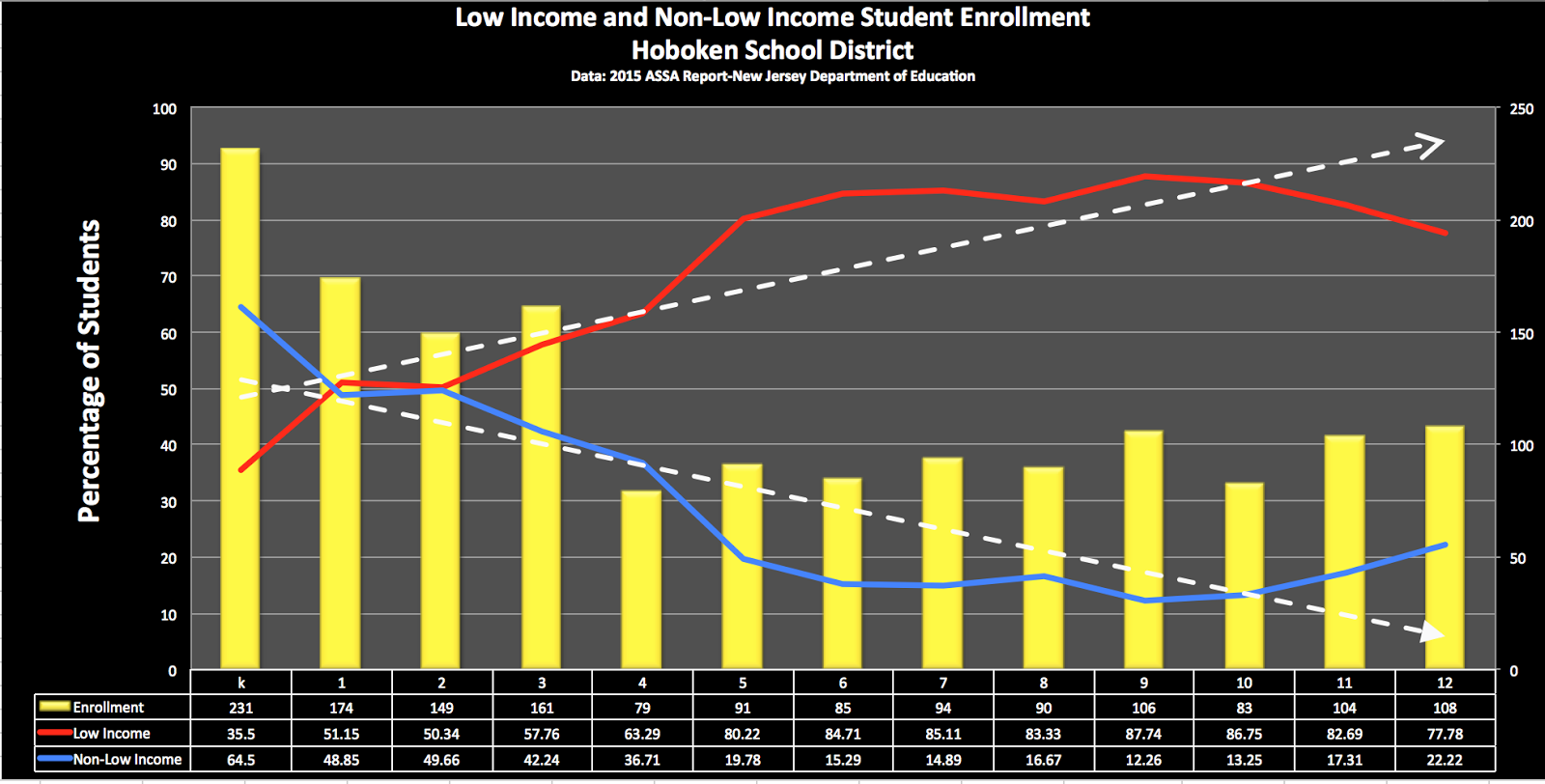
In fact, the entire Hoboken School District has been experiencing a steady decline in enrollment of students from families eligible for free and reduced lunch from 75% in 2007. But these drops are most experienced in the early grades (Prek-5) as many non-FRD families "opt out" of sending their children to the Hoboken Public Schools as their children reach the higher grades (Grades 6-12). Click here for a full analysis of the changing characteristics of students enrolled in the Hoboken Public Schools. 

The following two charts (Figure 1 and 2) show clearly that non-free and reduced lunch children are the majority in the Hoboken School District in the early grades. The disaggregated by grade charts below indicate fairly clearly both the drop in enrollment as well as the steady decline in non-FRD families from Kindergarten to 12th grade. When one looks at district numbers taken in totality (reported as "district percentages"), this level of detail is not apparent. 


Figue 1: 2010
Click to Enlarge

Figure 2: 2015
Click to Enlarge

While I was Assistant Superintendent we added the research based "Tools of the Mind" PreK and Kindergarten curriculum as well as the "LitLife" as well as Read 180 to specifically to address Language and Reading in the Hoboken Schools. Most of these programs are no longer in place or vastly reduced. Scores were on the rise. Hopefully, they will be again soon. 

The Hoboken Public Schools under the "Kids First/Continue the Progress/Forward Together" leadership as well as all other school districts' rankings are included below...
Here is the list:

Thursday, October 30, 2014

Under Kids First and Ruth McAllister (Tyroler)/Leon Gold/Mark Toback Leadership Analysis Shows Hoboken Public School District Ranked 490th out of 558 Public School Districts in New Jersey- Schooldigger.com


Hoboken Board Trustee and President Ruth McAllister (Tyroler) is fond of saying how much better the Hoboken School District is today than when she was first elected to the Hoboken Board of Education in the spring of 2009. In a few previous posts, independent, objective, and independent evidence was presented that might question some of the Board President's claims. Anyone who is interested in details that challenge her claims should Click Here and Click Here. 

Now there is additional data indicating Ms. McAllister (Tyroler) may want to reconsider her self congratulatory end of meeting remarks.  Last month we learned the QSAC DPR in Instruction and Program was a 45 out of 100 and marked the Hoboken Board's third consecutive year of failing to pass state mandated criteria for this DPR (recall, Trustee McAllister (Tyroler) was the Chair of the District's Curriculum Committee for the past 4+ years). Now we read about some additional analysis done by schooldigger.com, a site which ranks schools and school districts based on their most recently reported test scores. The test scores are calculated by taking the average math and English scores across all grades and adding them together for a combined score. District rankings are calculated by averaging the rank percentile of the schools within  each district. 

In this schooldigger.com analysis the Hoboken Public School District is ranked 490th out of 558 public school districts in New Jersey (bottom 12%). This evidently is the "improvement" after 5 years of leadership by Board President McAllister (Tyroler) and her Kids First political group. 

From schooldigger.com

The ranking should come as little surprise. In November of 2011 the school district was declared a District in Need of Improvement by the NJ Department of Education for the first time in district history after over 30 months of McAllister's (Tyroler) and Kids First leadership.

Failing scores on INSTRUCTION AND PROGRAM, a district labeled a District in Need of Improvement by the State Department of Education, and a ranking of 490 out of 558 must be difficult to sell as "improvement" to an informed public. Even more challenging must be the recent ranking of Hoboken as the 9th most violent school district in the State of New Jersey by Patch.com. But, it seems even that ranking was not a one time occurrence as we examine the multi-year trend of violence and vandalism in the Hoboken School District under Kids First and McAllister's (Tyroler) leadership:

Click to Enlarge

Click to Enlarge 

Again, notions of improvement can be subjective and riddled with opinions and spin. Sometimes presenting independent, objective, and non-partisan data depicts a circumstance or presents a counter narrative that differs from campaign promises or ego driven defensive rants.

Taking a page out of Ms. McAllister's (Tyroler) playbook, we read this in a recent Hoboken Reporter cover story:  

Monica Stromwall, who recently took over the chairmanship of the school board’s curriculum committee, defended the Hoboken’s school administration.
“Test scores are always a concern in any district, but steady progress is being made,” she said. The district’s steady application of consistent assessment and intervention programs are working and we will continue to support this.”
Here is one graph challenging the statement that "steady progress is made".....

...steady progress is being made


Tuesday, November 1, 2016

NJ and Hoboken School District Scores for Grade 8 2014-15 PARCC Mathematics Under Kids First-Forward Together Leadership

CLICK TO ENLARGE
The 2014-15 PARCC assessments for 8th Grade Mathematics indicate not only does the Hoboken School District score below the NJ State average but the district is next to last it its own District Factor Group. The District Factor Group system was developed by the New Jersey Department of Education as a way to compare "like" districts based on a number of socioeconomic factors. In this way, the state allows districts to compare themselves with districts facing the same challenges and opportunities as other similar districts. For a complete listing of all NJ school districts and their district factor group (DFG) please CLICK HERE. 

District Factor Group (DFG) data: 
1) Percent of adults with no high school diploma
2) Percent of adults with some college education
3) Occupational status
4) Unemployment rate
5) Percent of individuals in poverty
6) Median family income

Therefore, even when accounting for the socioeconomic conditions of the school district, students in the Hoboken School District came in next to last among its similar districts (FG) across the State of New Jersey. 

2009 Kids First Mailer- back when it was acceptable to
complain about test scores and bash the school district
CLICK TO ENLARGE 


  This is not improvement. This is not progress. These are facts. This is reality. 

Click on the following links for 2014-15 PARCC Results in ALGEBRA 1, ALGEBRA II, and LANGUAGE ARTS_9.

When we see the consistent low scores in Mathematics Grade 8, Algebra I, and Algebra II under the Kids First-Forward Together led Hoboken School District we must start thinking that something more systemic may be at hand. In the next couple of days we will drill down further into the district Math scores to see if these low scores and rankings exist at the lower grades as well. 


Monday, May 20, 2013

Keys to Effective District Leadership...and the Consequences and Ramifications of Poor Leadership

Former Intrim Hoboken Superintendent
of Schools- Mr. Peter Carter (2009-2011)

I recently came across a very thoughtful piece on what it takes to be a thoughtful and effective educational leader in a school district-- essentially, what makes a good superintendent? The four characteristics are 1) Make the Rounds, Open, Relaxed Conversation, Town Hall Accessibility, and Establish a Satellite Office. And, as I reflected on these characteristics I could not help but be reminded of the former interim Superintendent of the Hoboken Schools, Mr. Peter Carter who said at his initial meeting with the faculty of the Hoboken School District in September 2009 where he stated (paraphrasing)... "When you see me, don't talk to me" Safe to say, Mr. Carter probably had different characteristics as a school leader that differed significantly from these 4 characteristics and characteristics I tried to establish in the district (see below). One of Mr. Carter's characteristics may have led to a recent settlement by the School Board and one of its former principals (Dr. Lorraine Cella) on harassment issues. ( note: After having her school named "Second Most Improved High School in the State of New Jersey" by New Jersey Monthly and being recognized in successive years by US NEWS AND WORLD REPORT as a Bronze Medal Award Winner, Dr. Cella was informed she would likely not be retained for the 2010-2011 school year). 

Peter Carter, of course, was the unanimous selection of the Kids First Board Majority of the Hoboken Board of Education and he served as superintendent from September 2009 to the Spring of 2011- a period where the Hoboken School District experienced the beginning of its well documented decline in state rankings, school violence, student population decline, increase in "school choice" students from Jersey City, the elimination of Adult Education resident at Hoboken High School (adults now need to travel to all parts of Hudson County), drop in ranking in NJ Monthly and US NEWS AND WORLD REPORT, and increase in per pupil spending....culminating in the district being designated as a "district in need of improvement" by the New Jersey Department of Education in November of 2011. Leadership does matter.  -Dr. Petrosino 
----------------
The key to building relationships that will strengthen an educational leader's vision is being highly accessible and spending quality time talking and listening to teachers and support staff. This might seem like old news to veteran educators, but with email and social networking as the prevailing ways of communication, it is worth reminding leaders that there is no substitute for pressing the flesh.


Here are my four suggestions toward becoming a more effective leader.

1. Make the Rounds

Be a presence in schools each day. I make a point to start my morning in the hallways and then conduct my walks before the day gets ahead of me. Start the day in the office, and you're likely to end the day in the office (save for that weekly administration team meeting). An educational leader's work clock runs at least seven hours. How much time can one possibly spend in meetings and doing office paperwork? Just by cutting one to two hours out of my office day to spend a few minutes in each classroom and hallway of my small school district, I’ve learned more about the little (but often very important) things going on than I would have learned from email, phone calls or hearsay. Besides learning about the evolving culture of my schools, walking the hallways every day and being highly accessible has been key to showing everyone that I care about the school district at every level.

2. Open, Relaxed Conversation

Invite a school leader's cabinet to an early takeout dinner once per month. A conglomeration of parents and teachers sitting around Chinese food can lead to the same open, relaxed conversations we might have on the town soccer fields. A wonderful way to learn about what's really happening in the local community is to break bread (or egg rolls) in a casual setting on a regular basis.

3. Town Hall Accessibility

Hold vision town halls during which you share your short-, mid- and long-term goals in a conversation-style gathering. The meeting could be held in a classroom to set the context. You want to make it absolutely clear that your vision is all about children.

4. Establish a Satellite Office

I have a second, smaller office in another school district location. I took this cue from another American president, Woodrow Wilson, who heavily promoted a change in the way government operated by making frequent visits to Capitol Hill. He set up shop in the building's President's Room as often as three times per week to help him complete his work in the presence Congressional legislators. Wilson used the power of personality to engage the people on whom he depended to enact his proposals, and his satellite White House allowed for this engagement to happen naturally.

When I was the Assistant Superintendent of Schools in Hoboken I began nearly everyday at one of the 6 schools in the district. Often I was at the Wallace School yard, sometimes I was at Connors, other times at Hoboken High School. The idea was simply to be around and accessible. I would often talk to parents, teachers, administrators and sometimes students. I would also make it a point to visit at least 1 school a day. This was part of the way I tried to MAKE THE ROUNDS. As anyone who worked with me knows, I always tried to create an OPEN, RELAXED CONVERSATION and atmosphere. Whether it was with the Curriculum Committee, or my leadership cabinet, or meetings with parents and people from the community. To complement this relaxed atmosphere, I tried to have TOWN HALL ACCESSIBILITY. In part this was accomplished daily by my blog which gave a detailed account of what was going on in the district on a weekly and often a daily timeline. In addition, I would make numerous updates to the public at Board of Education meetings and I held a dozen "open forums" with parents and the community on issues related around curriculum, assessment, and special programs in the district. Finally, I made a SATELLITE OFFICE in Brandt School which served as a place for the district to do professional development, meet with parents, work on curriculum, and generally engage in the work of the district in a relaxed and less formal atmosphere. 

Wednesday, February 20, 2019

The Uncomfortable Truth About the Hoboken Public Schools: State Scores and District Rankings are at Historically Low Levels

Parcc 2018 Flyer by on Scribd

These scores and rankings do not indicate that the Hoboken School District is anywhere close to being a "model of excellence" for anything- let alone for diverse communities. Such statements are a mockery and are insulting to anyone paying attention to the Hoboken Public Schools. Thankfully for people overseeing education in the Hoboken district, there is no active news coverage of the district other than the public relation releases the district sends to the local newspapers. Issues related to the new QSAC scores will be addressed in an upcoming post.


Furthermore, the 2018 New Jersey Monthly Magazine ranking of NJ school districts finds the Hoboken School District dropping 48 spots and is now ranked 260th out of 300 school districts in NJ. Only in Hoboken is dropping 48 slots on a statewide independent ranking considered "making improvement" or warrants assurances that students are "college ready" or gets a superintendent an extension on a contract.

                                                       2018  2016            City                               County
2018 New Jersey Monthly Magazine- Best High Schools in NJ Issue


Wednesday, October 29, 2025

Hoboken Board of Education Candidates' Summary of Answers to Key Questions (Part 1)

Recently, Hoboken Board of Education  candidates were questioned on a number of issues concerning public school education in Hoboken. Today is Part 1 of a two part analysis of the candidates' responses. The original answers to the surveys can be accessed on Hoboken Patch (Responses 1; Responses 2).  

 Part 2 of this summary will be published on Friday (October 31), and a final ranking will be published shortly afterwards. 


This year, the candidates for three open spots are:

  • Leslie Norwood (incumbent)
  • Antonio Grana (incumbent)
  • Elizabeth "Lizy" Velez 
  • Russ Koyfman
  • Laura Block
  • Tim Smith

Here’s a concise comparison of the candidates’ responses to Longer Question 2 (Biggest Challenge), Longer Question 4 (Overall Impression of the District), and Longer Question 6 (Facilities Plan and Buildings):


Longer Question 2 – Biggest Challenge Facing Hoboken Schools

Similarities:
All five candidates agree that space and facilities are the district’s biggest challenges. They consistently connect enrollment growth with aging infrastructure and the need for expansion. Everyone acknowledges that the district’s academic performance is strong and that physical capacity must now catch up with success.

Differences:

  • Velez, Graña, and Norwood take a strategic, policy-oriented view, discussing data, financing models (like Public Private Partnerships), and long-term planning.

  • Block and Smith focus more generally on learning more about facilities and securing funding, showing less familiarity with specific policy mechanisms.

  • Velez emphasizes community engagement and communication after the failed referendum.

  • Graña stresses his state-level experience and coordination with developers and the city.

  • Norwood highlights the academic implications of facilities design, tying space needs directly to educational quality.


Longer Question 4 – Overall Impression of the District

Similarities:
All five praise the district’s trajectory, academic performance, and dedicated staff. Each expresses pride in Hoboken’s progress and optimism about its future.

Differences:

  • Norwood provides quantitative data (AP scores, rankings) and links them to district initiatives, reflecting a data-driven, governance mindset.

  • Velez focuses on special education inclusion and her personal experiences as a parent.

  • Graña centers his response on confidence in district leadership and his insider’s perspective as a current trustee.

  • Block’s answer seems incomplete or repeated from another question, offering little substance beyond a general desire for collaboration with the city.

  • Smith is positive but brief, noting the district is doing “an excellent job” without elaboration.


Longer Question 6 – 2022 Facilities Plan and Future of Buildings

Similarities:
All five agree that facilities need improvement and that space constraints persist. Most supported (or would have supported) the 2022 plan conceptually.

Differences:

  • Velez, Norwood, and Graña voted for or supported the 2022 plan but criticized its lack of community input. They see future solutions requiring both transparency and creative financing.

  • Block also supported the plan but focuses mainly on securing funding, offering less about process or engagement.

  • Smith opposed continuing the same approach, emphasizing that the community’s rejection must be respected and that future efforts must start from consensus rather than advocacy for the old plan.

  • Norwood provides the most detailed analysis, citing building age, capacity data, demographic projections, and state requirements—showing deep understanding of both facilities management and governance.


Summary

  • Consensus: Space and facilities are the dominant issue; the district’s performance is strong.

  • Differences: Norwood, Graña, and Velez are strategic and data-informed; Block and Smith are community- and parent-oriented but less specific on governance.

  • Distinctive Strengths:

    • Norwood: Most detailed and policy-grounded.

    • Graña: Experienced, pragmatic, systems-level thinker.

    • Velez: Analytical advocate with empathy for diverse learners.

    • Block: Genuine community volunteer.

    • Smith: Grounded listener emphasizing community consensus.


Thursday, April 24, 2025

It Is Not All About Test Scores in Hoboken...There are Other Things as Well

From time to time I post on social media and my posts often initiate comments from various people often with differing perspectives. My latest post about Algebra I scores seems to have inspired a fair amount of discussion. Here is my general reply to many of the posts I would also like to point out that there were many supportative comments from people as well. The important thing is to have a productive dialogue. -Dr. Petrosino 


I appreciate the passion for Hoboken’s students and the experiences you’ve described. It is important to celebrate student successes and the creative programs that exist in the district. However, it is also essential that we confront some hard truths when assessing the overall health of our public school system.
First and foremost, my concern has never been exclusively about test scores—but rather about what they can indicate when viewed alongside other data points. The issue is not rankings for rankings' sake, but whether our students are consistently receiving instruction that meets or exceeds New Jersey State standards across all subjects and grades. The data—available to all—suggests persistent areas of underperformance that cannot be dismissed.
Moreover, this discussion must be situated within a broader and troubling context:
Fiscal Stewardship: Hoboken’s school budget has grown at an alarming rate—proposing over 24% last year (eventually a 14% increase) and an additional planned 9.4% this year (2025-26).These increases demand clear, transparent justification and tangible improvements in student outcomes.
Enrollment Claims: The district continues to cite overcrowding, while simultaneously accepting over 160 out-of-district students annually through the “Choice” program. This contradiction must be addressed honestly.

Click to Enlarge


Most Recent Algebra I Results: Recent New Jersey State testing clearly shows 78% of Hoboken students tested by the state in Algebra 1 are not meeting NJDOE expectations. 80% of economically disadvantaged students tested by the state in Algebra 1 are not meeting NJDOE expectations. 75% of non-economically disadvantaged students tested by the state in Algebra 1 are not meeting NJDOE expectations. 

The vision some shared—of students engaging in hydroponics, global travel, and immersive technologies—is commendable and should be part of any 21st-century educational system. But vibrant field trips and scholarships for a select few cannot mask the systemic issues impacting the many. Equity demands we hold all aspects of the system accountable—not just celebrate its brightest moments.
Respectfully, if we are to truly serve all children in Hoboken, we must be willing to ask the tough questions and address the uncomfortable realities. Only then can we ensure that every student—not just a few—is equipped for a future full of real possibility. Again, I want to thank everyone for their engagement. I suspect we wish for the same things --- but our approaches clearly differ.


Here are some supportive statements that were made to my posts recently that I would also like to share:

1) how does displaying facts about the district equate to “hating” Hoboken? It’s because he cares about the district and town he was raised in that he brings up the data. He loves Hoboken and is more than qualified to comment and provide data to all those brainwashed by the Hoboken Public School district PR firm’s false narrative.
Dr. Anthony Petrosino is recognized as a founding board member of the Hoboken Dual Language Charter School (HoLa). He has publicly acknowledged his role in the school’s establishment and has been actively involved in its development and advocacy.
Dr. Petrosino’s background includes extensive experience in education, having served as a teacher, administrator, and academic. He has held positions such as Assistant Superintendent of Schools for the Hoboken Public Schools and has been involved in various educational initiatives. 
His contributions to HoLa have been part of a broader commitment to advancing bilingual education and fostering academic excellence within the community.

2) It’s incredibly disheartening to see our students caught in the middle of a failing system—one propped up by a disingenuous superintendent, an ineffective Board of Education, and a PR machine more focused on spin than substance. They push a narrative of a “thriving” high school, but informed parents aren’t buying it. Many are choosing to pull their kids from the district long before high school, and the declining enrollment numbers speak for themselves.
This is exactly why there’s no genuine need for a new high school—enrollment isn’t going to capacity of current HS, when trust in leadership is so low. A staggering 14.9% in tax increase in 2024 and 13% increase in 2025, this has delivered zero measurable progress. This isn’t growth. It’s failure. Plain and simple. #Hoboken
Why is not one mayoral candidate addressing it?