This was posted on social media on July 29th 2025.... very concerning

This was posted on social media on July 29th 2025.... very concerning


Many traditional Italian-American parishes celebrate the feast day of their patron saint. In Hoboken, that’s St. Ann’s. Of course, there are other St. Ann’s churches around the country—and even a major cathedral in Canada—but here in Hoboken, the feast is a big deal.
Following Italian custom, on the feast day, the statue of St. Ann is brought out of the church and carried through the streets of the parish—sometimes across the whole city. Years ago, it was believed that women who were pregnant or hoping to become pregnant would carry St. Ann barefoot. Over time, shoes replaced bare feet, and these days, the statue is rolled rather than carried on shoulders.
There was also a tradition where the men of the parish would carry the statue down and up the church steps, but only the women were allowed to carry her through the streets.
The feast usually lasts about a week, leading up to July 26. Each night there’s a novena in the church, and outside, it’s like a block party: food, music, raffles, games, and people greeting friends they haven’t seen in years. The celebration brings the parish and the larger Hoboken community together—and it helps raise money to support the church.
For many, the feast feels like a homecoming. It’s a chance to return to the church where they were baptized, received First Communion, were confirmed, got married—or saw family and friends do the same. It centers people. It connects past and present.
Growing up, St. Ann’s Day was treated like a local holiday. My parents, aunts, uncles—and a lot of folks in the neighborhood—didn’t go to work. They took the day off. It was religious, yes, but also very much about community. And it still is.



 |
| Chart 1: Seating Capacity 2000-2001 Worksheet |
 |
| Table 1: 2010 Hoboken District Audit (J-18) |
Seeing the World through a Mathematical Lens: A Place-Based Mobile App for Creating Math Walks
Award Number: 2115393
PI/co-PI(s): Anthony Petrosino, Cathy Ringstaff, Candace Walkington, Koshi Dhingra, Elizabeth Stringer
Report Type: Annual Project Report; Continuing Grant
Report Period: 08/01/2024 to 07/31/2025
Submitted By: Candace Walkington, cwalkington@smu.edu
Program Officer Name: Leilah Lyons
Program Officer E-mail: llyons@nsf.gov
Program Officer Phone Number: (703) 292-0000
Your project report has been successfully submitted to NSF.
Information about the grant: https://www.nsf.gov/awardsearch/showAward?AWD_ID=2115393&HistoricalAwards=false
ABSTRACT
This award is funded in whole or in part under the American Rescue Plan Act of 2021 (Public Law 117-2).
Math is everywhere in the world, but youth may see math as disconnected from their everyday experiences and wonder how math is relevant to their lives. There is evidence that informal math done by children is highly effective, involving efficiency, flexibility, and socializing. Yet, more is needed to understand how educators can support math engagement outside of school, and the role these out-of-school experiences can play relative to the classroom and lifelong STEM learning. This Innovations and Development Project seeks to conduct research on a location-based mobile app for informal mathematics learning. This research takes place at 9 informal learning sites and involves iteratively designing an app in which learners can view and contribute to an interactive map of math walk ?stops? at these sites. Learners will be able to select locations and watch short videos or view pictures with text that describe how mathematical principles are present in their surroundings. For example, learners could use the app to discover how a painting by a local Latino artist uses ratio and scale, or how a ramp in downtown was designed with a specific slope to accommodate wheelchairs. Research studies will examine the affordances of augmented reality (AR) overlays where learners can hold up the camera of their mobile device, and see mathematical representations (e.g., lines, squares) layered over real-world objects in their camera feed. Research studies will also examine the impact of having learners create their own math walk stops at local informal learning sites, uploading pictures, descriptions, and linking audio they narrate, where they make observations about how math appears in their surroundings and pose interesting questions about STEM ideas and connections they wonder about.
This project draws on research on informal math learning, problem-posing, and culturally-sustaining pedagogies to conduct cycles of participatory design-based research on technology-supported math walks. The research questions are: How does posing mathematical scenarios in community-imbedded math walks impact learners? attitudes about mathematics? How can experiencing AR overlays on real world objects highlight mathematical principles and allow learners to see math in the world around them? How can learners and informal educators be engaged as disseminators of content they create and as reviewers of mathematical content created by others? To answer these questions, five studies will be conducted where learners create math walk stops: without technology (Study 1), with a prototype version of the app (Study 2), and with or without AR overlays (Study 3). Studies will also compare children's experiences receiving math walk stops vs. creating their own stops (Study 4) and explore learners reviewing math walk stops made by their peers (Study 5). Using a community ethnography approach with qualitative and quantitative process data of how youth engage with the app and with each other, the project will determine how the development of math interest can be facilitated, how learner-driven problem generation can be scaffolded, and under what circumstances app-based math walks are most effective. The results will contribute to research on the development of interest, problem-posing, informal mathematics learning, and digital supports for STEM learning such as AR. This project will promote innovation and have strategic impact through a digital infrastructure that could be scaled up to support STEM walks anywhere in the world, while also building a local STEM learning ecosystem among informal learning sites focused on informal mathematics. This project is a partnership between Southern Methodist University, a nonprofit, talkSTEM that facilitates the creation of community math walks, and 9 informal learning providers. The project will directly serve approximately 500 grades 4-8 learners and 30-60 informal educators. The project will build capacity at 9 informal learning sites, which serve hundreds of thousands of students per year in their programming.
This Innovations in Development project is supported by the Advancing Informal STEM Learning (AISL) program, which seeks to (a) advance new approaches to and evidence-based understanding of the design and development of STEM learning in informal environments; (b) provide multiple pathways for broadening access to and engagement in STEM learning experiences; (c) advance innovative research on and assessment of STEM learning in informal environments; and (d) engage the public of all ages in learning STEM in informal environments.
This award reflects NSF's statutory mission and has been deemed worthy of support through evaluation using the Foundation's intellectual merit and broader impacts review criteria.
PUBLICATIONS PRODUCED AS A RESULT OF THIS RESEARCH
Note: When clicking on a Digital Object Identifier (DOI) number, you will be taken to an external site maintained by the publisher. Some full text articles may not yet be available without a charge during the embargo (administrative interval).
Some links on this page may take you to non-federal websites. Their policies may differ from this site.
From Classroom to Community: Evaluating Data Science Practices in Education and Social Justice Projects by Tony Petrosino on Scribd
Look at the chart below and notice the incredible drop in capacity that occurred in the district buildings just as Elysian and Hoboken Charter were coming online and were requesting space. It is all here in black and white...
 |
| Click to Enlarge |
 |
| Click to Enlarge |
The current figures show that Wallace School is operating six students under capacity, Connors School is 15 under, Brandt School is 121 over capacity, Demarest Middle School is 8 over, and Hoboken High School is 220 students under capacity. These numbers include the 160 students currently enrolled through the CHOICE program, most of whom attend Hoboken High School.
If the CHOICE program were sunsetted—allowing currently enrolled students to graduate while admitting no new students—the district would gradually recover those 160 seats at the high school level over the next four years. This would bring the high school’s available capacity to approximately 380 open seats, significantly increasing flexibility in student placement and program design at the secondary level.
The only schools currently over capacity are Brandt and Demarest. Wallace and Connors both have available space, and the closure of Calabro School in 2020, which removed 137 seats from the system, likely contributed to current crowding in some elementary schools. However, with a phased end to the CHOICE program and more strategic use of existing space, the district has sufficient capacity across its schools to manage current and near-future enrollment levels.
Given this audited data and the likely future availability of space at the high school given some administrative decisions, there appears to be no urgency for new building construction based on enrollment and capacity.

 |
| Click to Enlarge |
 |
| Click to Enlarge |
 |
| Chart 1- NJDOE ELA 2023-24 |
 |
| Chart 2- NJDOE Math 2023-24 |
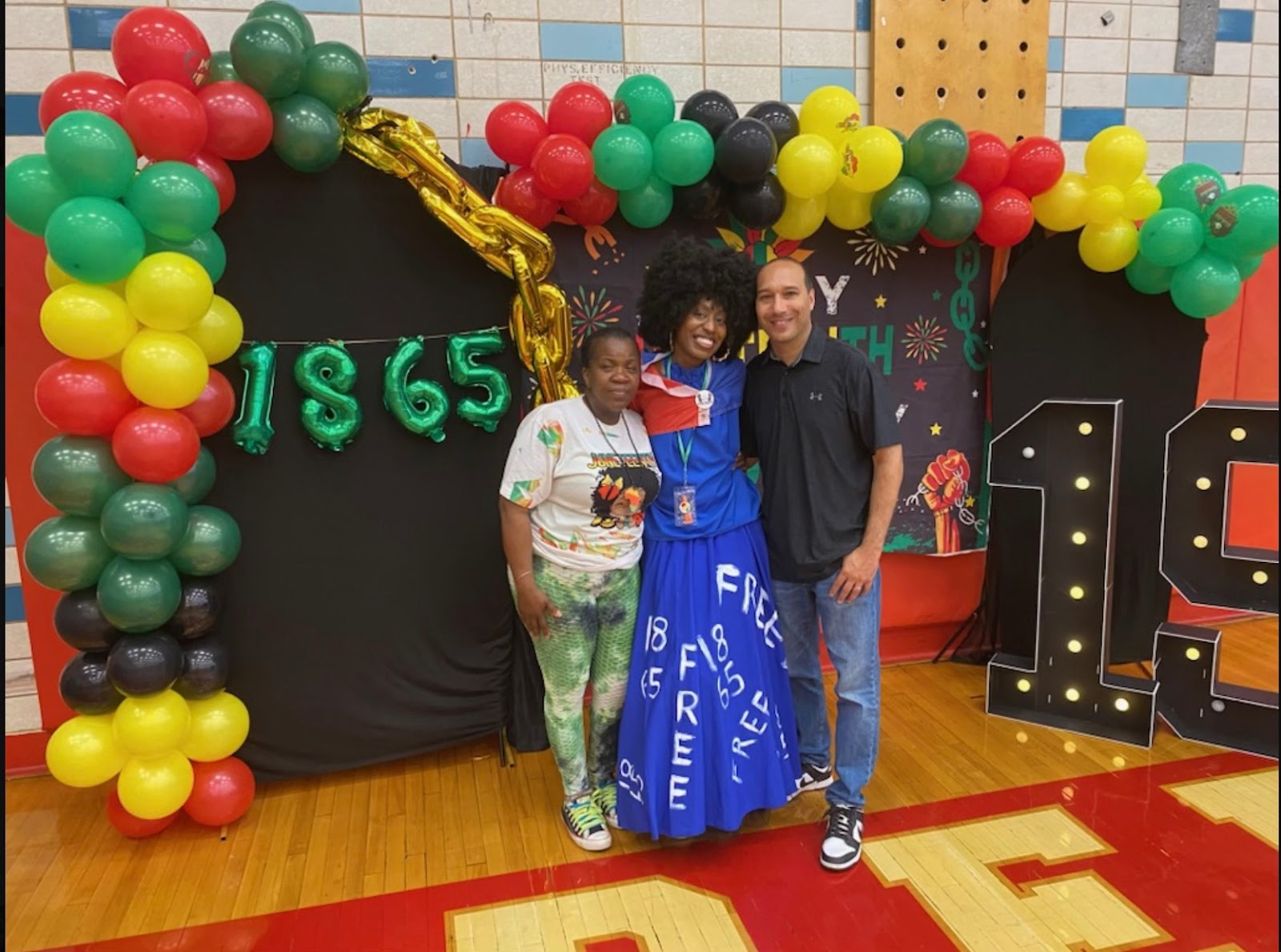
But let’s be clear: reflection without action is performative. It’s easy to pose for pictures and quote from history; it’s much harder to confront the uncomfortable present. The truth is, Black students in Hoboken are being failed academically (see Chart 1 and Chart 2), year after year, in a system that has every advantage—small class sizes, strong funding, stable staffing. These are not the conditions of scarcity. These are the conditions where excellence should be the norm—and yet, that excellence is not being delivered equitably.
If we are serious about honoring Juneteenth, we cannot look away from the data. When only a fraction of African American students are reading and doing math at grade level, it’s not a coincidence—it’s a systemic breakdown. And it is time to name names: school boards, superintendents, administrators, and yes, classroom educators all share in the responsibility for these outcomes. Equity is not a buzzword—it’s a deliverable. And right now, it’s being underdeliveredand underprioritized.
Hollow celebrations mean nothing if they’re not backed by bold leadership and measurable progress. We don’t need more hashtags and photo ops—we need accountability, urgency, and a plan. Hoboken owes its Black students more than symbolic recognition. It owes them a future.
The most recent released NJDOE disaggregated data (17 2210 HUDSON HOBOKEN) show that Hoboken's Black and Hispanic students are scoring drastically below their White peers in ELA and Math. These are not just academic gaps—they are systemic failures that directly threaten students' futures. In the 21st-century workforce, literacy and numeracy are essential for nearly every career. When students of color are left behind in these core areas year after year, Hoboken isn’t just failing state-mandated and required tests—it’s failing entire communities.
 |
| CLICK TO ENLARGE |
 |
| CLICK TO ENLARGE |
 |
| CLICK TO ENLARGE |
The 2023-24 data released by the New Jersey Department of Education paint a troubling picture of educational equity in Hoboken. While headlines might praise the district’s above-average performance compared to state benchmarks, a more honest and critical look reveals a deeply segregated academic reality. White students in Hoboken are thriving at exceptional levels, while African American and Hispanic students are, in many cases, experiencing systemic academic neglect. These disparities reflect not just achievement gaps, but opportunity gaps—symptoms of deeper institutional failures in leadership, pedagogy, and accountability.
In Grade 3, 71% of Hoboken students met or exceeded expectations in ELA—significantly above the state average of 43.6%. But this number masks the truth: 80% of White students met the standard, compared to only 36.4% of African American students and 44.9% of Hispanic students. That means two-thirds of African American students and more than half of Hispanic students in Grade 3 are not reading or writing at grade level. This is not a new trend—it is a systemic failure that continues throughout the grade levels.
This pattern suggests that instructional practices, early literacy interventions, and culturally responsive curricula may be either inadequately implemented or entirely absent for non-white students. The district's leadership must confront the uncomfortable truth: some students are being served far better than others, and it is often along racial lines.
 |
| Click to Enlarge |
Math scores deepen this concern. While the overall district performance looks strong on paper, the racial disparities are appalling. In Grade 3, 81.2% of White students met expectations, while only 18.2% of African American and 40.8% of Hispanic students did. By Grade 8, 0% of African American and only 3.6% of Hispanic students demonstrated grade-level proficiency. These are not just numbers—they are indictments.
Such disparities raise critical questions: What instructional supports are being provided to students of color? Are the best teachers equitably distributed across the district? Is the curriculum being differentiated effectively? And more importantly, where is the leadership in addressing these disparities year after year?
 |
| Click to Enlarge |
Science scores echo this grim trend. Although statewide science proficiency is generally low, Hoboken’s White students outperform the state by a large margin in 11th grade (32.4%), while African American and Hispanic students drastically underperform (5.3% and 2.5%, respectively). The equity gap here is not merely a reflection of student effort or socioeconomic status—it is a reflection of systemic neglect.
 |
| Click to Enlarge |
Summary
The Hoboken Public School District’s reputation for academic excellence is built on uneven ground. The data expose a district that, while high-achieving on the surface, perpetuates educational inequality behind closed doors. African American and Hispanic students are systematically underperforming in every subject and grade level analyzed. These aren't anomalies—they're patterns. And patterns point to institutional issues.
It is time for Hoboken’s educational leadership to be held accountable—not just for aggregate test scores, but for the moral and professional responsibility of ensuring equity. This includes investing in teacher training, reallocating resources, and committing to targeted interventions that address the needs of underserved students. Anything less is a continued failure.
Note: Charts shown above include solid black lines for state averages and dashed black lines for Hoboken's overall performance to aid in clarity and comparison.

Years later, when I returned to the Hoboken Public Schools as a teacher, and eventually as Assistant Superintendent, I had the honor of working alongside him. Richard never changed—he remained the same steady, supportive, and principled educator I remembered from my childhood. His encouragement meant a great deal to me throughout my career.
In addition to his work at School No. 8, Richard taught history at Demarest and served with distinction for 17 years as principal of the Calabro School. He also served for a time as Interim Superintendent of Schools—always answering the call to lead when his city needed him.
His dedication extended beyond the classroom. Richard was a longtime member of St. Ann’s Parish, helping at the feast for many years, and an active member of the Hoboken Elks Lodge #74, where he chaired the Scholarship Committee for over a decade. His political service as Councilman-at-Large and Second Ward Councilman was marked by integrity and care.
Richard E. Del Boccio embodied the very best of old Hoboken. He was a gentleman in every sense—respected, admired, and never forgotten. -Dr. Anthony Petrosino
