Wednesday, March 15, 2017

The University of Texas at Austin's College of Education Ranked 4th Among Public and 11th Overall Nationally for 2018 by US News and World Report

The University of Texas at Austin has more than 40 graduate programs ranked among the top 10 in the nation and four programs ranked No. 1, according to U.S. News & World Report's 2018 edition of "Best Graduate Schools," released this week.

U.S. News & World Report’s graduate rankings, separate from the magazine's yearly ranking of undergraduate programs, are among the most widely regarded ratings in higher education. They are based on surveys of academic leaders and, for select programs, additional quantitative measures including placement test scores, student/faculty ratios, research expenditures and job placement success.

The College of Education at The University of Texas at Austin is ranked 11th nationally (No. 4 among publics), with four specializations in the top 10.

  • Administration/Supervision – 6th
  • Curriculum/Instruction – 8th
  • Education Policy – 16th
  • Educational Psychology – 8th
  • Elementary Teacher Education – 12th
  • Secondary Teacher Education – 11th
  • Special Education – 5th
For a more complete picture, I finished my Master's in Educational Administration from Teachers College, Columbia University (#7 tie) before receiving my PhD from Vanderbilt University (#7 tie). After completing my PhD, I did a post doc at the University of Wisconsin-Madison (#3 tie) before joining the faculty at The University of Texas at Austin (#4 public, #11 tie nationally)- See Figure 1. 

Figure 1


Monday, March 13, 2017

Petrosino, A. J. and Mann, M. (in press). The Challenges of Fluid Density. Journal of Continuing Education and Professional Development

The Journal of Continuing Education and Professional Development is a peer-reviewed international journal in the general field of continuing education and professional development. It tries to provide a platform to scientists, engineers, educators, and policy makers to discuss new discoveries on continuing education, lifelong learning, and professional development.

Topics of interest include, but are not limited to: Curriculum design, Virtual laboratories, Interactive knowledge media, New technologies, Team learning, Competency assessment, Policy making, Challenges and trends.

Index- Academic OneFile, EBSCO, Google Scholar

Dear Dr. Petrosino,

I am pleased to inform you that your paper The Challenges of Fluid Density has been accepted for publication in the Journal of Continuing Education and Professional Development.

Please submit your final proof (WORD file) at https://cipt3.submittable.com/submit/2XXX7

The format guidelines are listed at
http://uscip.us/Authors/ManuscriptFormat.aspx

Kindly copy and paste your manuscript contents into the template at
http://uscip.us/Authors/MXXXXcriptXXXmat.aspx

Make sure:
(1) the CIP header and the CIP logo are included.
(2) tables and figures are inserted into the body text

Sincerely,

Journal of Continuing Education and Professional Development
http://jcepd.uscip.us

-->
Abstract

Teachers’ understanding of science concepts must be deeper than just factual knowledge. They need to understand how the facts are connected and relate to the natural world. Weather, ocean currents, and tectonic movement are all phenomena listed in the Next Generation Science Standards (NGSS). Although understanding density of fluids within fluids is not directly mentioned in the NGSS, students need to understand fluid density in order to explain these common yet complex phenomena. We extended a familiar science activity of making a density column in order to help teachers understand the expectations of NGSS. Understanding the causes of the phenomena is critical for teachers. We found when students do not understand, they are more likely to substitute concrete or active causal factors, such as weight or force. We issued to our teachers the following challenge: “Make a density column with these 4 mystery liquids.” As our students were in the process of determining the correct order to add the liquids, we noticed they confused mass and viscosity with density. In light of the expectations of the NGSS, we need to change the way teachers are prepared. They need time and space to practice connecting the concepts in practice. Therefore, teachers need help to connect the concepts to past experiences as well as time to reflect and revise. Teachers need to develop a mindset as a lifelong learner powered by their reflections and drive to help students understand science.

Keywords: Professional Development; Density; Next Generation Science Standards; Science Concepts; Fluid Density; Domain Knowledge

Thursday, March 9, 2017

STEM Faculty and Doctoral Students Thrill Elementary Children and Families with "Cloud in a Bottle" Session During Explore UT Day


Passing along a little write up that was done centering around some outreach efforts from ongoing research projects I have. Incredible effort pedagogically and content wise by doctoral students Jason Harron, Sneha Tharayil, Sarah Jenevein, and Wan Sin Lim. Some of this work is funded by the National Science Foundation. -Dr. Petrosino

As a reputed institution of public higher education, exploration is fundamental to a university's mission. This ideal though is not only reserved for the daily pursuits of faculty, staff, and students, but researchers revel in sharing it with the wider community. Nothing exemplifies this more than UT’s annual Explore UT day, where people from all corners of Texas are invited to explore what Longhorns are exploring. This year, Explore UT day was held on Saturday March 4th, 2017. Among those excited to welcome our visitors and share with them the work they’re doing at UT was Dr. AnthonyPetrosino a learning scientist in the College of Education's STEM Education Program, and a team of graduate students who work with him: Jason Harron of the LearningTechnologies program, Sneha Tharayil, Sarah Jenevein, and Wansin Lim, all from the STEM Education program.

Dr. Petrosino’s team planned some thrilling sessions in which children of all ages and adults were able to make a real cloud in a bottle (using just a regular one-gallon clear plastic bottle, a little bit of ethanol, and a bicycle pump) and explore the science behind it. In addition, visitors got to participate in and experience Jason’s innovative research in using virtual reality in education. Jason has designed easily-accessible virtual reality spaces of real places like the Texas Memorial Museum, UT’s Campus, and even the surface of Mars, which can be viewed and interacted with using Google Cardboard googles. All one needs is a smartphone with Internet access and a pair of Google or Unofficial Cardboard googles and they’re flying over Mars, or walking around the Texas Memorial Museum right from their seats of his/her classroom or home, miles away!


Overall, the sessions were a huge success, as evidenced by the room quite literally overflowing with people and visitors. People were eager to crowd in wherever they could, sitting on the floors and standing along the edges of the room and even spilling into the nearby hallways just to catch a glimpse or snippet of whatever they could! We were so pleased to hear the “oohs and ahhss!” of wonderment by both children and adults alike, and field the rich, curious questions and ideas from our visitors. It was a refreshing reminder of our purpose and mission here at the STEM Education and Learning Technologies departments in the College of Education. Next year though, we’ll be sure to reserve a much bigger room ;)!


Friday, March 3, 2017

Development of Museum Learning Experience Using Virtual Reality and Mobile Devices (Harron, Petrosino, and Jenevein, 2017)

The following is a paper I will be presenting at the 28th Annual meeting of the Society for Information Technology and Teacher Education. It is research I have been conducing with two incredible doctoral students over the past 12-18 months. We are now in the process of a followup study as well as writing up some additional data for another publication.

SITE–Society for Information Technology and Teacher Education promotes the development and dissemination of theoretical knowledge, conceptual research, and professional practice knowledge through the SITE conference, books, collaborative projects with other organizations, and the Journal of Technology and Teacher Education.

SITE (founded in 1990) is a society of AACE–Association for the Advancement of Computing in Education. AACE (founded in 1981) is an international, educational, and professional organization dedicated to the advancement of the knowledge, theory and quality of learning and teaching at all levels with information technology.


Reference:
Harron, J., Petrosino, A. J., Jenevein, S. (2017). Development of Museum Learning Experience Using Virtual Reality and Mobile Devices. Paper presented at the Society for Information Technology and Teacher Education (SITE) conference, Austin, TX: LearnTechLib Publishing.

Monday, February 27, 2017

Lucero, Petrosino, and Delgado (2017) Exploring the Relationship Between Secondary Science Teachers’ Subject Matter Knowledge and Knowledge of Student Conceptions While Teaching Evolution by Natural Selection

Figure 1: Journal Rankings
Click to Enlarge
Recently, two colleagues and myself published an article in the Journal of Research in Science Teaching (JRST). The Journal of Research in Science Teaching, the official journal of NARST: A Worldwide Organization for Improving Science Teaching and Learning Through Research, publishes reports for science education researchers and practitioners on issues of science teaching and learning and science education policy. Scholarly manuscripts within the domain of the Journal of Research in Science Teaching include, but are not limited to, investigations employing qualitative, ethnographic, historical, survey, philosophical, or case study research approaches; position papers; policy perspectives; critical reviews of the literature; and comments and criticism. It is currently the third highest ranked journal in the field (see Figure 1). -Dr. Petrosino 

Abstract: The fundamental scientific concept of evolution occurring by natural selection is home to many deeply held alternative conceptions and considered difficult to teach. Science teachers’ subject matter knowledge (SMK) and the pedagogical content knowledge (PCK) component of knowledge of students’ conceptions (KOSC) can be valuable resources for helping students learn difficult science concepts such as natural selection. However, little research exists that explores the relationship between science teachers’ SMK and their KOSC on evolution by natural selection. This study explores the relationship between SMK and KOSC through the participation of four biology teachers at a single high school and thus deepens our understanding of the teacher knowledge base. Main data sources are teacher interviews in which each teacher answered SMK-type questions and predicted what their students’ most common alternative conceptions were by using the Conceptual Inventory of Natural Selection (CINS). Other data sources include student responses on the CINS and classroom observations. Findings revealed relative independence between SMK and KOSC, although there is likely a minimum threshold of SMK to recognize student alternative conceptions. However, our work also revealed ways in which teachers were not leveraging their KOSC and suggest potential avenues for future inquiry. # 2016 Wiley Periodicals, Inc. J Res Sci Teach 54: 219–246, 2017 Keywords: pedagogical content knowledge; subject matter knowledge; teacher knowledge of student conceptions; evolution; natural selection

Sunday, February 26, 2017

JOYCE TYRELL - Hoboken High School Teacher, Principal of Our Lady of Grace School, Active Hoboken Citizen

Joyce Tyrell
JOYCE TYRELL HOBOKEN Joyce Tyrell of Hoboken died Wednesday, February 22, 2017. She was 84. Born in Hoboken, Joyce was a lifelong resident. Mrs. Tyrell was a graduate of Montclair State University where she received a Bachelor of Science in mathematics and a minor in music. She then earned her Masters Degree from Montclair in mathematics. Joyce taught in the Hoboken school system and was chairwomen of the mathematics department for grades K-12. She also taught Computer Science at Keane College and was a Principal of Our Lady of Grace Grammar School. Joyce served on the Hoboken Planning Board and theHoboken Historic Commission. Joyce is predeceased by her parents Joseph Tyrell and Johanna (nee Hopf). She is also predeceased by her brother Jack Tyrell and sister Dorothy Richards. She is survived by her nephew George Richards. Friends will be received at the Earl F. Bosworth Funeral Home, 311 Willow Ave., Hoboken on Sunday from 4-8pm. The Funeral Mass will be held at Our Lady of Grace Church, Hoboken on Monday, February 27th at 9:30am. Entombment to follow at Clove LeafMemorial Park in Woodbridge NJ. EARL F. BOSWORTH FUNERAL HOME 311 WILLOW AVE HOBOKEN , NJ 07030 (201) 659-1455 - See more at: http://obits.nj.com/obituaries/jerseyjournal/obituary.aspx…. (RIP) Miss Joyce Tyrell.


Thursday, February 23, 2017

Resilience to Change- Expert Blind Spot Among Preservice and Inservice Teachers: Beliefs About Algebraic Reasoning and Potential Impact on Engineering Education

The following is a final draft of a paper that will be submitted for publication within the next few months and will also be presented at a national conference focusing on engineering education, algebraic learning and teacher preparation. I'm writing with a colleague of mine from the University of Michigan.  In this study, we examine the differences in teachers’ held perceptions about algebraic representational problems (symbolic, word, and story) between pre-service and in-service teachers participating in a teacher education program. Further, I explore further the expert blind spot in algebraic teaching and its implications for K-12 engineering education and the STEM pipeline.-Dr. Petrosino

Friday, February 17, 2017

Michele Russo- August 7, 1949 - February 16, 2017

My sincere condolences to the Russo family, to Anthony Sr, Nicky, Michael, Anthony Jr, on the passing of their Wife/ mother Michele Russo and to the DeStafano family. Mrs. Russo was a tireless advocate and supporter for the children of Hoboken. Michele sponsored Hoboken Recreation Cheerleaders, Ragamuffin Parade, Summer Olympics, Senior Flower Program, Hoboken's Haunted House, Movies Under the Stars, Concerts in the Park, all with pure heart and soul. She was a relentless volunteer for anyone who needed help, you wanted her on your side. Michele's generosity has been recognized throughout the city, by all the countless people in need. 


IN LOVING MEMORY
MICHELE RUSSO
Michele Russo (née DeStefano), born and raised in Hoboken, NJ died on February 16, 2017 surrounded by Family.
Born on August 7, 1949 to Mary and Pasquale DeStefano, Michele Russo is survived by her husband, former Hoboken Mayor Anthony Russo, son Nicholas (Nick) S. Russo, his wife Olivia and children Jenna Rae, Anthony Evan, Lucien Thomas and Nicolo James; son Hoboken Third Ward Councilman Michael S. Russo, his wife Lisa and children Lia Grace and Jack Anthony; and son Hoboken Police Officer Anthony P. Russo, his wife Aliesette and daughter Ava Liana; her brothers Anthony and George DeStefano, and a number of nieces and nephews.
Renowned as a hard working civic volunteer and community leader, Michele’s dedication to Hoboken flourished in the 1990’s as a founder and Coach of the Hoboken Devils Recreation Cheerleaders, now Hoboken Cheer Dynamics.  Also, with the establishment of the Anthony Russo Civic Association, Michele Russo led the effort to “Turn the Tide”, becoming “First Lady” of Hoboken from July 1993 through June 2001.
Michele’s life and commitment to her beloved City of Hoboken brought decades of service as an elected School Board Trustee, Chairwoman of the Hoboken Democratic Organization, Hoboken Parking Authority Commissioner, Board Member of HOPES and organizer of the annual “Hoboooken Haunted House” and countless other community events.
Michele Russo was a loving mother, sister, grandmother, aunt and wife of 45 years.
Public Visitation - Monday, February 20th - 2:00 PM to 9:00 PM at Failla Memorial Home, 533 Willow Avenue, Hoboken.
Mass - Tuesday, February 21st - 10:00 AM at St. Francis Church, 308 Jefferson Street, Hoboken.
In lieu of flowers, memorial contributions to her home parish of St. Francis Church in Hoboken or her founding quest Hoboken Cheer Dynamics. Envelopes will be provided at the funeral home.

Monday, February 13, 2017

February 2017: Full Detailed Agenda Hoboken Board of Education

We Will Not Give Up- Roc Strong 


Tuesday, February 14, 2017
AGENDA
 HOBOKEN BOARD OF EDUCATION
158 FOURTH STREET, HOBOKEN, NJ 07030
(MEETING HELD IN DEMAREST AUDITORIUM, 158 FOURTH STREET, HOBOKEN, NJ 07030)

7:00 P.M.

Friday, February 10, 2017

Answers to Questions About Choice Students in the Hoboken School District: 166 (total) and 120 of 458 (HHS)

Quick Summary: The latest available NJDOE data indicates there are 166 choice students in the Hoboken School District. Additional data indicates 26% of high school enrollment in Hoboken High School are choice students. 

As regular readers will recall, the Hoboken School District is a receiving district for "choice" students from the surrounding area. But just how many students are there in Hoboken who are "choice" students and how many of them are enrolled in the high school. A fairly simple and straight forward question but one that is not very easy to ascertain. I have received a number of inquiries over the past few days concerning these questions and though that if a few people are interested, perhaps there are many more. 


This post will answer 2 questions. First, how many "choice students" are in the Hoboken School District. Second, what percentage of enrolled students in Hoboken High School are choice students? 

Question 1: The graph below is pretty straight forward and not only shows the number of choice students for the most recent school year (166) but also shows the continued rise of choice students since the 2009-10 school year. 

Chart 1: Number of Choice Students in Hoboken District
2009-10 to 2015-16
CLICK TO ENLARGE

Question 2: The second question is how many choice students are in Hoboken High School. I have include some of my data sources (see Chart 2 and Chart 3). According to the latest data, there were 458 total enrolled students in Hoboken High School with 120 of them being "choice" students. Therefore, based on the latest data, roughly 26% of the students in Hoboken High School are non-residents or "choice" students. 

Chart 2: 2015-15 Enrollment District Data- Hoboken School District

Chart 3: Disaggregated Choice Data by Grade 2015-16 School Year 

Comment: While a district cannot "pick and choose" all choice students, the district Board does control the number of choice students admitted to the school district as long as the number admitted is within the upper limit of state approved slots for the district. There is also no available analysis that I know of currently that has examined choice vs resident students on any specific measures. 


February 10, 2017- Hoboken Waterfront 

Monday, February 6, 2017

Free or Reduced Lunch Population Steadily Declines from 86.30% in 1998-99 to 52.55% in 2015-16 for Hoboken Public School District

Figure 1: 1998-2016 Free or Reduced Lunch Percentage
CLICK TO ENLARGE
The percentage of students identified as qualifying for Free or Reduced Lunch has declined from 86.30% in 1998-99 to 52.55% in 2015-16 for the Hoboken School District. 

According to Merrian-Webster dictionary white flight is the departure of whites from places (as urban neighborhoods or schools) increasingly or predominantly populated by minorities. Perhaps a more expansive approach to "white flight" might include socioeconomic status or class after all sometimes people use the term "white" as a euphemism for other conditions (class, income) which we may feel uncomfortable discussing. 

So, are charter schools having a segregative impact on the Hoboken Public Schools causing "white flight" as claimed by a number of Hoboken Board of Education members and realized in terms of an exodus of non-free or reduced students (a.k.a. "middle class")?

The short answer is that over the past 18 years the percentage of students identified as qualifying for free or reduced lunch has declined from 86% to 53% (see Figure 1). 


BACKGROUND: Over the past weeks I have received inquiries concerning the Free and Reduced percentages for the Hoboken School District. As many of you pointed out, the data I reported was from 2013-14 and was the most current available from the informative Eduction Law Center website. I have since done additional research and found more updated numbers for the 2015-16 school year. The updated percentages are similar and statistically not very different to 2013-14. I also decided to do a more longitudinal analysis and now have date for the past 18 years. 

For 2015-16 there were a total of 1943 students in the district and 1021 received either free or reduced lunch. This means the percentage of FRL students for 2015-16 in the Hoboken School District was about 53%. 

Figure 2: 2015-16 Hoboken City Enrollment Data
CLICK TO ENLARGE 
Recall, in 2013-14 the percentage as reported by the Education Law Center was 49%. 

Figure 3: 2013-14 Hoboken City FRL Percentages
CLICK TO ENLARGE

I did some additional research and looked up some archival data. 

For 2005-06, about a decade ago, there were a total of 1900 children in the school district and 1491 qualified for either Free or Reduced Lunch. This means the percentage of FRL in 2005-06 in the Hoboken School District was about 78.47%

Figure 4: 2005-06 Hoboken City Enrollment Data
Click to Enlarge
For 1998-99, the oldest data I could find fairly quickly, there were 2625 children in the school district and 2266 qualified for either free or reduced lunch. This means the percentage of FRL students for 1998-99 in the Hoboken School District was about 86.32%

Figure 5: 1998-99 Hoboken City Enrollment Data
Click to Enlarge 

After finding the 1998-99 data I thought it would be interesting to gather data for EACH year in order to get a more fine grain look at the data over a long stretch of time-- in this case, 18 years. This also compliments an analysis I did previously where we looked at the percentage of students identified as "white" in the Hoboken School District. 

Summary: "White flight" and segregative impact may be a challenge to convince open minded people and independent third parties when data indicates the percentage of white students have been on an 18 year rise (from @15% to 33%) AND the percentage of students from families meeting criteria for free or reduced lunch have declined significantly (from 86% to 53%) over the same time period in the Hoboken School District. 


“they’re (charter schools) fostering white flight, and they’re bankrupting us,” the city’s school board head charged in a Wednesday interview. “We are creating separate but equal school systems,” warned Hoboken Board of Education president Leon Gold -Salon (3/14/14)

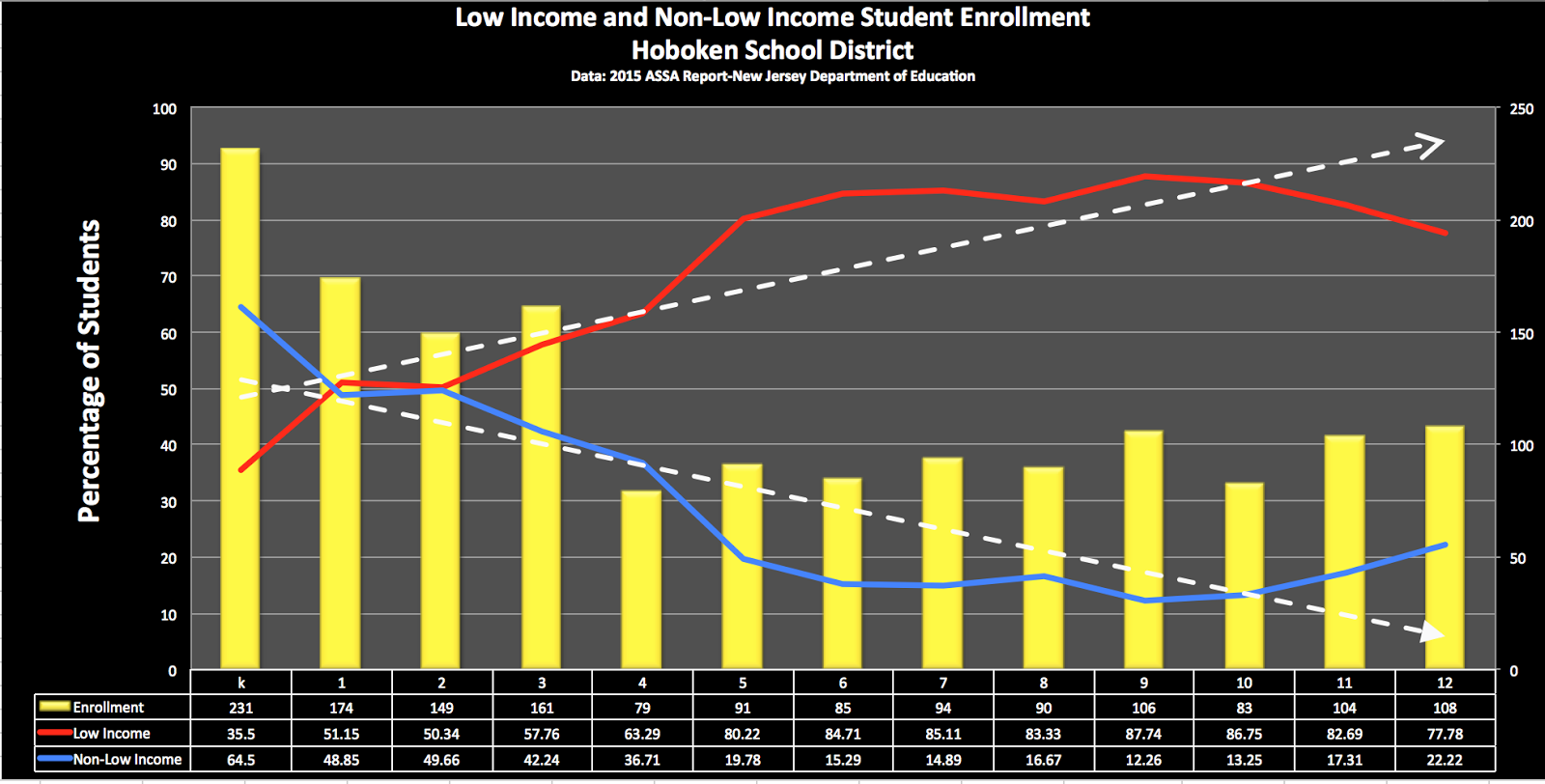
Further Clarification: Some regular readers of this blog pointed out that further clarification might be needed. I agree. It is important to understand that this data on Free or Reduced Lunch eligibility (Figure 1) is at the full district level and not disaggregated. Grade by grade analysis (i.e. disaggregated)  reveals different and also concerning trends of the Hoboken School District's inability to retain the non Free or Reduced eligibility population of students it has enrolled in the early grades (Figures 6 and 7 below). In short, the students categorized as non Free or Reduced Lunch eligible are primarily, although not exclusively, in the early grades. What percentage of the non Free or Reduced eligibility population of students that have left the Hoboken School District are also considered white is an interesting question but outside the focus of this particular post.

Figure 6- Example of disaggregated data

Figure 7- Example of disaggregated data


Thursday, February 2, 2017

White Flight Not Evident in 18 Year Longitudinal Analysis of the Hoboken Public School District Despite Claims by Advocates

Figure 1: Percentage of Students Defined as White in
Hoboken School District (1998-2016)
Click to Enlarge
According to Merrian-Webster dictionary white flight is the departure of whites from places (as urban neighborhoods or schools) increasingly or predominantly populated by minorities. 
Are charter schools having a segregative impact on the Hoboken Public Schools causing "white flight" as claimed by a number of Hoboken Board of Education members? 


One way to determine if white flight is taking place is to document the decrease in white students in the school district. It would make sense that if white flight was occurring, white students would be leaving the district and would be making up a smaller and smaller percentage of the student enrollment in the district. 

When we look at the data over an 18 year span, we find the percentage of students designated as white is actually increasing in the Hoboken Public School District...and significantly(!)

In fact, the percentage of white students in the Hoboken Public School District has risen from 14.98% in 2000-01 to 33.2 % in 2015-16- an increase of over 120%. Moreover, since the Hola Dual Language School was founded in 2010-11 the percentage of white students in the Hoboken School District has risen from 22% to 33%.

The trend line (dotted arrow- Figure 1) clearly shows the percentage of white students in the Hoboken Public School District has been on the rise for the past two decades with no evidence of a plateau. White flight, as measured by the decline in the percentage of white students in the Hoboken School District, is not taking place in the Hoboken School District and in fact, has seen a steady increase since 1998-99. 

CLICK TO ENLARGE