Wednesday, March 16, 2016

U.S. News Rankings Released

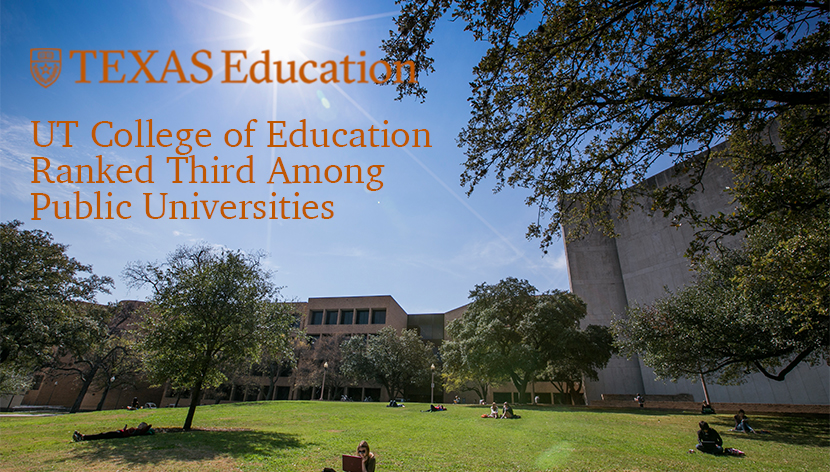
U.S. News and World Report has just released its graduate school rankings. The College of Education at The University of Texas at Austin is ranked 10th overall and has maintained its third-place ranking among public universities.
“I’m very proud that the college has maintained its extraordinarily strong national showing in the face of both limited federal funding and an increasingly competitive market for top faculty and top graduate students,” says Dean Manuel Justiz. “I thank our faculty and College of Education family for providing our students with an excellent education and leading our field with cutting-edge scholarship and research. Their contributions keep us competitive among our peers.”
In addition to the college’s number three spot, the college is ranked second in research expenditures among publics. Specific programs and specialty areas also placed strong within the top 10, with two rising in rankings.
Administration/Supervision: Second among publics and third overall
Special Education: Third among publics and fourth overall
Educational Psychology: Fifth among publics and sixth overall, up from 10th last year
Curriculum and Instruction: Fourth among publics and seventh overall, up from 11th last year
Additionally, three programs placed within the top 20:
Elementary Teacher Education: Eighth among publics (tied with Ohio State University), 11thoverall, up from 15th last year
Secondary Teacher Education: 13th among publics (tied with University of Minnesota-Twin Cities), 18th overall
Education Policy: 10th among publics (tied with University of Southern California-Rossier), 18th overall
Rankings are but one indicator of excellence. The College of Education continues to develop strategies to secure funding for research, recruiting and retaining faculty, and for programs such as the Dean’s Scholars Fellowship Program, which helps recruit the best and brightest graduate students.

Sunday, March 13, 2016

The Superior Social Skills of Bilinguals - NY Times KATHERINE KINZLER

Spring begins in Hoboken- March 11, 2016
This is a portion of a full article that appears in the New York Times on further benefits of being bilingual. This article focuses on an often undercooked area...social skills. Previous studies have shown benefits in cognitive skills, self regulation, critical thinking, and problem solving. All reasons why some colleagues and I wanted to bring a dual language program to the children of the public schools of Hoboken, NJ. Unfortunately, that proposal was rejected by the Hoboken Board of Education and led to the submission and eventual approval of the Hola Dual Language School. The school is now regionally recognized as a leader in dual language innovation and instruction and standardized test scores are through the roof. Unfortunately, the vast majority of the children of Hoboken still do not have bilingual education as a viable option as the Hoboken Public School District has been either unable or unwilling to offer a dual language program to their students. Perhaps that is one reason why the waiting list for the Hola Dual Language program is hundreds of children long. -Dr. Petrosino

BEING bilingual has some obvious advantages. Learning more than one language enables new conversations and new experiences. But in recent years, psychology researchers have demonstrated some less obvious advantages of bilingualism, too. For instance, bilingual children may enjoy certain cognitive benefits, such as improved executive function — which is critical for problem solving and other mentally demanding activities.
Now, two new studies demonstrate that multilingual exposure improves not only children’s cognitive skills but also their social abilities.

One study from my developmental psychology lab — conducted in collaboration with the psychologists Boaz Keysar, Zoe Liberman and Samantha Fan at the University of Chicago, and published last year in the journal Psychological Science — shows that multilingual children can be better at communication than monolingual children.

In a second study, forthcoming in the journal Developmental Science, my colleagues and I examined the effects of multilingual exposure on even younger children: 14- to 16-month-old babies, who are hardly speaking at all. In this study, led by Zoe Liberman and in collaboration with Professor Keysar and the psychologist Amanda Woodward, babies were shown two versions of the same object, such as a banana, one of which was visible to both the infant and an adult, the other visible to the baby yet hidden from the adult’s view. When the adult asked the baby for “the banana,” the baby might hand her either object — both were bananas, after all — yet if the baby understood the social context, he would reach more often for the banana that the adult could see.

We found that babies in monolingual environments reached equally often for the two bananas. Babies in multilingual environments, including those who were exposed to a second language only minimally, already understood the importance of adopting another’s perspective for communication: They reached more often for the banana that the adult could see.


Multilingual exposure, it seems, facilitates the basic skills of interpersonal understanding. Of course, becoming fully bilingual or multilingual is not always easy or possible for everyone. But the social advantage we have identified appears to emerge from merely being raised in an environment in which multiple languages are experienced, not from being bilingual per se. This is potentially good news for parents who are not bilingual themselves, yet who want their children to enjoy some of the benefits of multilingualism.

Katherine Kinzler is an associate professor of psychology and human development at Cornell University.

Tuesday, March 8, 2016

Thousands of NJ Seniors at Risk of Not Graduating This June - Education Law Center

Hoboken High School Graduation 2015
photo: Hoboken Reporter 
Some interesting news from the Education Law Center concerning upcoming graduation rates in New Jersey. There seems to be some pending legal action with the new requirements. Worth keeping an eye on this develops over the near future. -Dr. Petroisno 

March 3, 2017
Last month, the NJ Department of Education (NJDOE) proudly announced that the state’s high school graduation rate had improved for the fourth straight year to nearly 90%, one of the highest in the nation. At the same time, new graduation policies imposed by the NJDOE threaten to sharply reverse this progress, with the greatest impact on our most vulnerable students and high need districts.

Over the past year, the NJDOE dramaticallyaltered the standard for high school graduation. The State substituted the new PARCC exams, with passing rates of 30-40%, for the previous graduation test, the High School Proficiency Assessment (HSPA), which typically had passing rates of 80-90%. The NJDOE also eliminated the Alternative High School Assessment (AHSA), used annually by approximately 10,000 students, including a large percentage of the state’s English Language Learners, to obtain a diploma.  (CLICK HERE) 

State education officials imposed these new policies without following the required legal process. This has led to a lawsuit filed by parents and students challenging the NJDOE’s authority to impose the new policies on current high school students. It also has created potential grounds for legal claims by students denied a diploma this June on the basis of improperly imposed graduation requirements.
More than half of the seniors in the class of 2016—over 50,000 students—did not receive scores on last spring’s PARCC tests that satisfy the new graduation requirements. These students are now scrambling to pass other tests on the NJDOE’s list of “substitute assessments,” or are asking their schools to submit complicated graduation appeals.

District educators, especially guidance counselors, are devoting scarce resources and time to extra rounds of testing and paper-heavy appeals at a time when they should be helping seniors plan for college and post-secondary opportunities. For example, data from Paterson indicates that over 600 seniors had not yet met the new requirements, and the district is arranging extra test administrations and preparing hundreds of appeals. Other districts are facing similar challenges.

In January, the NJDOE finally presented proposed rules to implement the new graduation policies to the State Board ofEducation. But, at best, it will be months before the State Board can adopt these proposals. In the meantime, the NJDOE continues to illegally impose its new policies retroactively on seniors and other students. 

In their lawsuit challenging the NJDOE’s new policies, the parents and students are asking an Administrative Law Judge to rule that the NJDOE violated the law when it imposed new graduation rules on high school students. They are also asking the Judge to order the NJDOE to implement the recommendations of the Governor’s 2012 College and Career Ready Task Force Report. This Report called for a multi-year transition period to phase in the PARCC tests during which “the state Department of Education will not establish a minimum passing score as a graduation requirement. Instead, graduation will be dependent on satisfactory completion of the required courses, as established by local boards of education, with accountability coming from a more robust transcript.”  (Final Report, p. 47).

Since 1979, New Jersey has changed high school graduation tests four times. However, the NJDOE has never used a new test as a graduation standard after only a single administration. This year, New Jersey is the only state in the nation using PARCC as a high school exit exam. The PARCC consortium, which originally had 26 members, is down to six states.

The NJDOE has failed to heed concerns raised by many educators, parents and advocates over the last several years. Now the State’s ill-conceived policies and failure to follow the law have created an upheaval that is jeopardizing the graduation prospects of seniors across the state. It is also clear that intervention by the courts and the Legislature is necessary to fix it.

Press Contact:

Sharon Krengel
Policy and Outreach Director
skrengel@edlawcenter.org
973-624-1815, x 24

Friday, March 4, 2016

What John Kasich got wrong about Detroit’s troubled schools in last night’s debate - Washington Post


Hoboken Railyards
There was much talk about Education at the recent GOP debate. Each candidate weighed in with Donald Trump (eliminate the Department of Education, eliminate Common Core, give money back to the states...) and John Kasich having the most to say. Here is Emma Brown's insightful piece in the Washington Post. -Dr. Petrosino 
Thursday night’s Republican presidential debate in Detroit did not only feature vulgar conversation about genitalia. It also featured the first really substantive question about K-12 education in the 11 GOP debates to date.
And that was apt given the setting. Detroit’s public schools are broken. They are $3.5 billion in debt and could run out of cash before the end of the school year, according to the Detroit Free Press. Children go to class in buildings with rats, roaches and crumbling ceilings. In some schools there are mushrooms growing out of the walls.
Fox News anchor and debate moderator Megyn Kelly put the question to Ohio Gov. John Kasich: “If the federal government bailed out the auto industry here in Detroit, should it also bail out the Detroit schools?”
Kasich never directly answered Kelly’s question. He suggested that Detroit schools are on the right track to improvement in part because they are under mayoral control.
“Well, look, first of all, I think the mayor now is controlling the schools,” Kasich said. “This is not much different than what happened in Cleveland, Ohio, where the African American Democrat mayor, the union and business leaders came to see me and said, ‘Would you help us to pass legislation to really create a CEO environment so that we can take control of the schools?’ ”
“It worked beautifully,” Kasich said. “Cleveland’s coming back. The Cleveland schools are coming back because of a major overhaul.” He went on to discuss the importance of vouchers and charter schools and vocational education, and he said that adults need to “put politics aside” and fight in their communities for stronger schools.
Leaving aside the question of whether mayoral control would really be enough to fix Detroit’s problems, there is this fact: Detroit is not under mayoral control. The city’s schools have been under state-appointed emergency manager for years.
As unsexy as it might sound, governance of the public schools has been a matter of heated debate in Detroit. Teachers — who have staged massive sickouts to protest the deplorable conditions of schools — say that the state has been neglecting the school system and has helped drive it into the ground. The Detroit Federation of Teachers has been pushing for a return to local control of the schools via a locally elected school board.
The state-appointed emergency manager of the school system was, until a few days ago, Darnell Earley. Earley previously served as the state emergency manager of Flint, Mich., from 2013 until January 2015. It was during that period that Flint began using the Flint River as its drinking water source, a move that led to elevated lead levels in the water and a public health crisis.
Earley stepped down on Feb. 29, and the new emergency manager is Steven Rhodes, a retired bankruptcy judge who has said that his first priority is working with the legislature to get Detroit schools the money they need to pay off debts, organize and continue operating.


Emma Brown writes about national education and about people with a stake in schools, including teachers, parents and kids.

Wednesday, March 2, 2016

School Board Basics: Frequently Asked Questions- New Jersey School Boards Association – Parent Connections

School Board Basics: Frequently Asked Questions
Who serves on the school board?
The school board consists of lay representatives – people who live in the community and are selected by the community (or, if it's an appointed school board, selected by either the mayor or county freeholders). They're your neighbors: parents, grandparents, local business owners, retirees – ordinary citizens. They are non-partisan and they receive no pay or benefits for their public service.

What is the role of the school board and the superintendent?
The school board has a dual role: To represent the concerns of the citizens, taxpayers and parents to the school administrators, and to represent the needs of the students and school district to the citizens, taxpayers and parents of the community. The school board does not operate the district on a day-to-day basis; that is the job of the superintendent, who is the district's chief executive. Rather, the school board sets the policies, goals and objectives for the district – and it holds the superintendent responsible for implementing the policies and achieving the goals.

I have a problem with my school. Isn't the school board the appropriate body to address it?
Maybe. We recommend working up the chain of command. For instance, if a parent has a problem with a teacher, the parent should first address it with the teacher and, if the issue is not resolved, the parent should turn to the principal or supervisor, and then the superintendent.The school board should be the "court of last resort." Many times citizens can get answers to their questions simply by calling the appropriate person in the school district (i.e., principal, school board secretary or superintendent).

Do I have an opportunity to speak at the board meeting?
State law requires a public comment period at board meetings. Boards are allowed to establish reasonable restrictions on the time, place and manner of public comment. For instance, school boards typically set guidelines on the length of an individual's comment (e.g., a certain amount of time per person), so no one person dominates the meeting. There is no required format for public comment; some boards have one public-comment period in the middle of the meeting, some have two public-comment sessions during a board meeting.

What is proper protocol for public participation?

Comments from citizens generally go through the chair at the board meeting, usually the board president. Boards use the public comment period as an opportunity to listen to citizen concerns, but not to debate issues or enter into a question-and-answer session or a "cross examination" between the public and individual members. Be aware that not all issues brought before a board meeting will be resolved that evening; boards may respond to public comment by seeking additional information or by delegating the authority to investigate the issue to the superintendent or his/her designee. While public education can be an emotional issue, and understandably so, the board will strive to maintain a certain level of decorum at the meeting. Many meetings are recorded or televised, and students often attend or participate in the meetings. As such, citizens are expected to maintain tone of courtesy and civility.

How does the board set its rules at the meeting?
A local school board's parliamentary procedure is a matter of local policy. Most boards follow Roberts Rules of Order, which describes how meetings are run, how motions and votes are taken and other procedures. The school board's secretary can inform citizens on rules of order and other issues of board policy.

The board goes into a closed-door meeting each meeting. Why can't the public witness what occurs there?
New Jersey's Open Public Meetings Act (also known as the Sunshine Law) specifies nine areas that are to be discussed in "executive" or closed-door session. Among the most common are privacy issues (including employee privacy as well as matters dealing with individual students and student discipline); anticipated litigation and issues involving attorney-client privilege; negotiations with labor unions and negotiating strategy; matters involving the purchase of property; and any issues dealing with security that could undermine safety if made public. Sometimes, citizens will want to know why a school board took a vote regarding a particular staff member (e.g., not re-hiring a teacher or principal). However, school board members are not allowed to publicly discuss evaluative aspects of the staff member's employment, unless the employee authorizes it.

What is the board agenda?
While school boards publicly post an annual notice describing the date and location of meetings, they are not required by law to post an agenda for each meeting. However, most do have an agenda. If they do, the agenda must reasonably reflect the matters to be discussed. However, the board is not precluded from addressing an issue that arises just because it was not on the agenda.

My school board seems to rapidly work through the agenda, without much debate. Why is that?
School boards sometimes have a "workshop" or "caucus" meeting where they discuss issues in greater detail, but don't vote on the issues. In addition, boards may utilize a committee structure, where certain members of the board, often working with the superintendent or key administrators, study a specific issue and make recommendations to the full board for a vote. By the time the board has a regular "agenda" or "business" meeting where it votes on issues, the agenda items have usually been vetted or studied already.

What is the difference between school board's policy and state regulations and statutes?
Statutes are the laws that are enacted by legislators in Trenton. Usually the law will contain broad language on an issue, and it will authorize the appropriate state agency (which would be the New Jersey Department of Education, or NJDOE, in the case of school law) to write regulations, also called "administrative code," that detail how the law will be carried out. Local public schools must adhere to state statute and regulations. There are many aspects of school management that the state does not manage. Those are covered by the local school board's policies, which are the school board's rules and guidelines that detail how the district will operate. Policies address many issues ranging from student discipline and dress codes to whether the district will rent the gym to community groups after school hours. The state generally does not delve into the oversight of local board policies unless there is a specific law requiring boards to have policies on an issue (such as school bullying), or if the local board's policies are found to be arbitrary or capricious, or have otherwise run afoul of state laws and regulations.

What role does the New Jersey School Boards Association (NJSBA) and the New Jersey Department of Education play?
The New Jersey School Boards Association is a service organization that provides training, assistance and advocacy for local school boards. However, NJSBA is not a state regulatory agency and does not have authority over local school districts. The New Jersey Department of Education (NJDOE) is the state agency that regulates public schools. If a citizen has an issue that cannot be resolved by working up the chain of command locally, he or she can bring it to the attention of the NJDOE. The department has county offices run by "executive county superintendents," and the county offices can often serve as an effective liaison between local residents and the NJDOE. Under the umbrella of the NJDOE is the School Ethics Commission, which hears cases involving conflicts of interest and possible violations of the School Ethics Act. The state Commissioner of Education, who is the chief of the NJDOE, also hears many cases dealing with education issues.

Source:  New Jersey School Boards Association – Parent Connections


Tuesday, March 1, 2016

Additional $1.2 Million to Hoboken for Pre-K Funding in Governor Christie's 2016-17 Budget

Cobblestones of Court Street near 5th Street
photo: Mark Critides
Governor Chris Christie (R-NJ) is proposing that for 2016-17 that Pre-K aid be kept at exactly the same amount it was at for 2015-16 for the state of New Jersey. That amount comes to $655,516,608. However, this does not mean that every single Pre-K district is getting the same amount of aid that it got last year. Due to increases in the number of children aged 3 or 4 in Pre-K districts, some of the aid shifts are very large. The Hoboken School District will come out as big winners with a proposed increase of $1,288,185 dollars above and beyond the amount allocated for 2015-16. Add to this the recent news of a $5,400,000 surplus from unspent funds in the 2014-15 budget and it would appear that the Hoboken district is not being as damaged as some proclaim from the expansion of 4 classrooms in a single charter school. 

For a much more detailed explanation on the increase in Pre-K funding, please point your browser to New Jersey Education Aid under an article entitled "Big Winners, Losers in Pre-K Aid."

The Big Gainers in Pre-K funding for 2016-17:

Proposed Pre-K Aid Increase2015-16 Pre-K Aid2016-17 Proposed Pre-K Aid
HOBOKEN $1,288,185$10,229,295$11,517,480
JERSEY CITY$923,574$67,499,148$68,422,722
FRANKLIN TWP$863,872$857,123$1,720,995
TRENTON$639,076$28,466,696$29,105,772

Tuesday, February 23, 2016

A letter from the HoLa Board president (Hoboken Reporter- Feb 21, 2016)

Aeriel view of Maxwell House and Lipton Tea area (1950's)
The following is a letter to the editor of the Hoboken Reporter dated February 21, 2015. It concerns the ongoing litigation by the Hoboken School District against the Hola Dual Language School in Hoboken, New Jersey as well as the New Jersey Department of Education. I have provided annotation when appropriate in order to provide more information for those new readers who may not know all the details surrounding this situation. -Dr. Petrosino 

Dear Editor: On behalf of the over 300 families of Hoboken Dual Language Charter School, I would like to thank Peter Biancamano, John Madigan and Britney Montgomery, for their courageous vote this week to end the expensive and divisive lawsuit against our beloved public charter school. This lawsuit seeks to undo the school’s expansion to 8th grade, which was approved two years ago, and is already underway.

All three of those members voted to end a lawsuit that has cost taxpayers over one-quarter of a million dollars, and counting. Unfortunately, the six-member majority on the board voted to continue a lawsuit that is unlikely to prevail on the facts.

The district has lost its arguments at every legal interval so far. We are now at the Appellate Court level (which has rejected the district’s request for an emergency stay) and we are facing expensive oral arguments by all three parties—the Hoboken district, HoLa, and the NJ Department of Education.

The Hoboken district has vowed not to use any more taxpayer money on their portion of the lawsuit—and at least two of the newest board members also committed to that when they were elected—but taxpayer money will still be spent by HoLa and by the state, and since only $11,000 has been raised to support the legal fund so far (much of it from among board members themselves), it is unclear how these mounting legal fees will be paid for. The board members promoting this lawsuit said that they have spent the $11,000 that has been raised, and only owe the district’s attorneys $9,000 more at this point. Residents should ask how that bill will be paid if the board members vowed not to spend any more taxpayer money, and how the district will pay for the oral arguments that are coming next and are likely to cost the district thousands of dollars. Further, if it has cost HoLa well over $100,000 just over the past year to defend itself, it seems incredible that it has only cost the district $20,000 over the same period, since they are using outside counsel to create their legal briefs, just as HoLa is.

It’s time to end this divisive lawsuit. HoLa has proven, over and over again, its commitment to equity in our city—for example, becoming the first charter in the state to offer a low income preference in its lottery. In addition, the data all show that HoLa is as beautifully diverse as this city and that the district’s students have not in any way suffered from HoLa’s creation or expansion. In contrast, this city is stronger for its full range of educational options for families.

It’s time to ensure that Hoboken families continue to have all of the educational options their children deserve.

Sincerely,
Barbara Martinez
President of the Board, Hoboken Dual Language Charter School

Friday, February 12, 2016

Video: Hoboken Board of Education Votes 6-3 NOT to Drop Hola/NJDOE Lawsuit--

A number of interesting observations as we watch a Board trustee (Peter Biancamano) make a motion to stop the Hola lawsuit. This is followed by a second to the motion by Trustee John Madigan. Next we see Trustee Montgomery call for a vote. What follows is part frustration, exasperation, sarcasm, and accusations of "poor Boardsmanship" as the Board members associated with the Kids First/Reach Higher, Hoboken political group are forced to publicly vote on a motion to stop the expensive, multi-year lawsuit against the Hola Dual Language Charter School. Best to watch it for yourself. The final vote was 6-3 with all 'Kids First/Reach Higher, Hoboken' board members voting to NOT stop the lawsuit...


Motion by Peter Biancamano, second by John Madigan.
Final Resolution: Motion Fails
Yes: Peter Biancamano, John Madigan, Britney Montgomery
No: Sharyn Angley, Jennifer Evans, Leon Gold, Irene Sobolov, Monica Stromwall, Thomas Kluepfel


Click to enlarge


Thursday, February 11, 2016

"Kids First/Reach Higher, Hoboken" Trustees Vote Not to Drop Lawsuit Against Hola and NJDOE at February 9, 2016 Board Meeting (INCLUDES VIDEO)

Ferguson Propeller Co. Hoboken NJ 1888-1990
At the Hoboken Board of Education meeting on Tuesday, February 9, 2016 a motion (see Figure 1) was made to drop the district lawsuit against the Hola Dual Language School (see Figure 2). The motion was made by Trustee Peter Biancamano (longest serving member of the current Board) and was seconded by trustee John Madigan (highest vote getter in the most recent Board of Education city wide election in November, 2015). The motion failed by a vote of 6-3. All members of the political group known as "Kids First/Reach Higher, Hoboken" voted against the motion. New trustee and former teacher Britney Montgomery voted to drop the lawsuit along with Biancamano and Madigan. 

Hola recently scored well above the state average in Math and English Language on the NJ PARCC for the 3rd, 4th, 5th, and 6th grades. 

Under the leadership of "Kids First/Reach Higher, Hoboken" the Hoboken Public Schools have the highest rate of violence,  vandalism, and bullying in Hudson County, New Jersey and have failed the NJ State monitoring QSAC DPR in Instruction and Program for four straight years. In addition, despite former Board President and current trustee Leon Gold's claim that Hola is "bankrupting the district" (see also this retort), the Hoboken School district had a surplus of $1.1 million for the fiscal year ending June 30, 2014 and over a $5,400,000 dollar surplus for the fiscal year ending June 30, 2015 (see 14:30-15:00 mark in this video). 

Figure 1:Click to Enlarge 


Motion by Peter Biancamano, second by John Madigan.
Final Resolution: Motion Fails
Yes: Peter Biancamano, John Madigan, Britney Montgomery
No: Sharyn Angley, Jennifer Evans, Leon Gold, Irene Sobolov, Monica Stromwall, Thomas Kluepfel

Figure 2: Hoboken Lawsuit asking the Renewal and
Expansion of Hola should be reassessed

Wednesday, February 10, 2016

Hoboken Board of Education Detailed Agenda- February 2016

Tuesday, February 9, 2016- AGENDA
HOBOKEN BOARD OF EDUCATION
158 FOURTH STREET, HOBOKEN, NJ 07030
(MEETING HELD IN DEMAREST AUDITORIUM, 158 FOURTH STREET, HOBOKEN, NJ 07030) 7:00 P.M.


Full agenda: CLICK HERE

Tuesday, February 9, 2016

Teachers Use of Data, Measurement, and Data Modeling in Quantitative Reasoning (Petrosino, 2016)

Parade on Washington St 1938
This chapter was inspired and motivated by participation in the Quantitative Reasoning session of the Waterbury Summit on “Reforming STEM Education – The Central Role ofPractices” held in University Park, PA in Summer 2013. The broad goals of the Summit were to discuss the redesign of K-12 education for alignment of curriculum-instruction-assessment; STEM teacher education; post-secondary STEM education and informal education on the publics’ engagement. Presentations and discussions centered on opportunities and challenges the Next Generation Science Standards present for (1) initial preparation of and continuing professional development of STEM educators and (2) the general education of the publics’ understandings about science and engineering practices. Overall, the summit stimulated a reconceptualization of STEM education with a focus on systems thinking, model-based reasoning, and quantitative reasoning. 

To organize this chapter, I articulate the role of data modeling including an emphasis on variability as a means of pursuing meaningful investigative activities in STEM classrooms. I continue by addressing some key components of an instructional sequence for scaffolding measurement, variability, and modeling in the pursuit of experiment in K-12 settings. Next, I discuss the role of pre-service teacher education and professional development in attempting to take some of these reform pedagogies to a larger scale than simple single classroom implementations. I conclude by discussing how quantification and measurement could forge links between integrating science and mathematics education.

Petrosino, A. J. (2016). Teachers Use of Data, Measurement, and Data Modeling in Quantitative Reasoning. In R. Duschl and A. Bismarck (Eds), Reconceptualizing STEM Education: The Central Role ofPractices (pp.167-180). New York: Taylor & Francis/Routledge.